
 Our faith is rooted in God’s promises and the saving work of Jesus Christ. What is the last promise you made? How did it go? Sure, sometimes we make promises and don’t keep them. When that happens what do we do? That’s right. We apologize and ask forgiveness. Figure out what may have interfered with keeping those promises and keep them next time! Promises are the roots of faith. From Genesis to Revelation and everywhere in between, the olive tree in the Bible is a metaphor for our faith. Taste these amazing olives. The Olive Tree has deep roots. Try one. Next time you see an olive, remember God’s promises for you in Jesus Christ! God loves you!
Oct
28
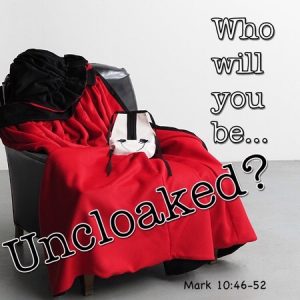 People don’t usually ask, “What costume are you going to wear for halloween?” No, instead we ask, “Who are you going to BE this year?” Halloween isn’t just about putting together a clever “costume.” It is about creating a personal “image.”
Mask wearing is always associated with this time of year for more than two millennia, and ironically, on October 31, 1517, Martin Luther pulled the “mask” off of the Church when he posted his 95 complaints on the neighborhood billboard. He saw the Church hiding and pretending to be something very unlike Christ. Along with John Knox in Scotland, John Calvin in Switzerland, and other reformers, he fanned the flames of the Great Reformation across Europe.
We all wear masks, and some masks are authentic and appropriate ways for us to interact in the world. But some masks we wear mey help us hid or pretend to be something we are not and not be part of a costume, at all. In this week’s text from Mark 10:46-52, we meet a man named Bartimaeus who becomes “uncloaked.” He shows us that when we come “face-to-face” with Jesus, any mask or pretense must fall away and our most basic needs and desires are revealed to the Son of David who has the power to heal us and heal the world, transforming us to be our real selves.
Romans 8:29-30 The Message (MSG)
“God knew what he was doing from the very beginning. He decided from the outset to shape the lives of those who love him along the same lines as the life of his Son. The Son stands first in the line of humanity he restored. We see the original and intended shape of our lives there in him. After God made that decision of what his children should be like, he followed it up by calling people by name. After he called them by name, he set them on a solid basis with himself. And then, after getting them established, he stayed with them to the end, gloriously completing what he had begun.”
Now, that’s transformation!
Oct
28
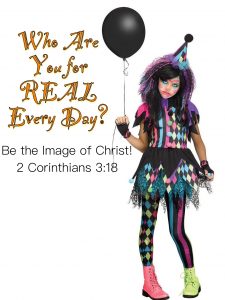 Who are you on Halloween? You look costume looks great, by the way! What does your very cool image say about you? Bright colors? Character-like qualities? Stylizing for attention? Sure. All these things. If Jesus were to dress up for Halloween, who would he be? Well, he’d be who he was all the other days of his life, too. Jesus was authentic. He presented himself as he was. He treated everyone with dignity and respect. He showed amazing love for everyone, all the time, and in every context of life. The Bible says he is the true image of the invisible God. If we have seen Jesus, we have seen God! So this Halloween, be creative with your cloaks and masks. It’s good fun. But who we are for Halloween, and every other day of our year ahead, can also be who we are for real! A child of God who looks like Jesus. Be uniquely Christ for Halloween, and every other day!
Oct
21

 Remember growing up with the Sears Christmas Wish Book? I do. Flipping through pages filled with toys and gift ideas delighted kids of all ages as they marked their favorite items, hoping mom and dad noticed in time for Christmas. What did you wish for?
 Beginning in 1886, 22-year-olds Richard Sears and Alveh Roebuck did more than wish for a brighter future when they started a retail business that sold, well, anything. Whatever you wanted, watches, clothes, furniture, chances were that Sears, Roebuck, and Co., could deliver it to your door. In fact, they could deliver the door, too, attached to the pre-fabricated house you purchased out of the catalogue! The business seemed to peak in 1969, ironically as it built what was then the “largest skyscraper in the world” in Chicago.
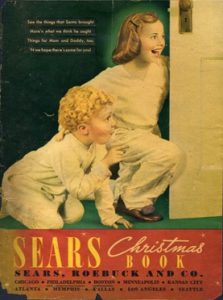
Diversifying into other product lines from brokerage, insurance, and pre-internet services failed to improve the company’s health, and by the 1990’s, Walmart, and later internet companies like Amazon, made the Sears and the Christmas Wish Book obsolete. Desperate attempts to stay afloat couldn’t save the struggling retailer, which listed $6.9 billion in assets and $11.3 billion in liabilities. An economist explained the retailer’s demise: “Sears and Kmart simply trudged along and thought that was good enough.” Good enough is rarely good enough, and on October 15, the Sears Holdings Corp. filed for Chapter 11 bankruptcy after 132 years in business. While sad, there’s more for us to learn from the wish book story.
What do you want? Jesus asked this question of his good friends, James and John, and you wouldn’t have guessed what was on their wish list! This Sunday, let’s get our wish lists out for Jesus to examine. We will also take a look at Job’s wish list, too, and we’ll discover that God delivered more than Job bargained for!
Oct
21
2018-10-21 Message for Kids- I have the faith of a mustard seed, and I’m not afraid to use it
By cscadmin Sermons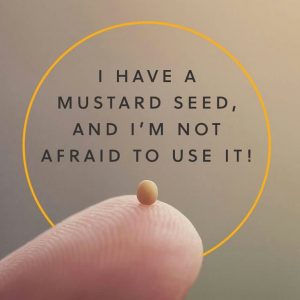 What do you need when you go trick or treating? Candy, right? What’s you favorite? Sure. Twist. Snickers. Skittles! But, what do you need? Not candy! How about faith? Jesus said that if you have faith even a small as this mustard seed, you can move mountains! Here is a mustard seed. Can you even see it? It’s super small. It’s one of the very smallest of the seeds, yet it grows and produces a great plant. You probably don’t need more candy, and guess what? You don’t need more faith, either. All you need to do is trust in God and know that God loves you more than you could possibly know, and wants your very best and has given you all you truly need in Jesus Christ. So this Halloween, as you fill your bag with candy, fill your life with faith and see what God will do!
What do you want for halloween? Candy?
What do you need for Halloween? Faith!
Oct
07
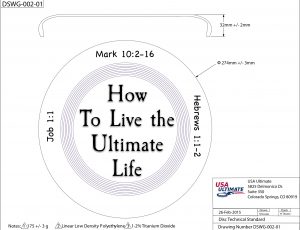 Jesus said, “I have come that you might have life, and have it abundantly” (John 10:10). The word abundantly could also be translated ultimately. Jesus sails our life can be an ultimate life, a life experience beyond our greatest hopes or soaring imaginations! This week, we will find out how to live an ultimate life as we consider three related Bible texts about integrity, living our lives with a coherent sense of truth, respect, and character (Job 1:1ff; Hebrews 1:1-2ff; and Mark 10:2-16.) We will also learns few lessons from the Frisbee!
More than sixty years ago, the Frisbee flying disk was created by Walter Morrison and Warren Franscioni, in part inspired by the Roswell flying saucer sensation and originally called the Pluto Platter. Frisbee’s now famous name is a spin-off from a defunct Connecticut bakery, Frisbie Pie Company. New England college students often tossed empty pie tins around for fun, a habit that led them to refer to the Pluto Platter as a “frisbie.” Recently, the Frisbee is earning an even greater recognition than being one of the most well-known and well-loved flying toys of all time. The International Olympic Committee is considering adding competitive Ultimate Frisbee to the official sports line-up. (Ultimate will be the only sport not to have one of these _____. Can you guess? Listen for the correct answer!) This week at Cold Spring Church, find out how Jesus’ words and Ultimate Frisbee can inspire you to lead the Ultimate Life!
Oct
07
 What are some rules you remember? No running down the hallway? Sitting quietly in class. Hands and feet to yourself! Sure. Rules are necessary so that everyone can be treated fairly, with dignity and respect. We live our best life when we follow the right rules. You know, the game of Frisbee has rules, too. Here’s a Frisbee for you. Our game is to toss the Frisbee to the pew and the rule is throw it just hard enough so that it doesn’t end up in rear of the sanctuary! And it has to land on the bench. O.K. Play! Great. So each of you played the game and you followed the rules. God has given us some rules, too. We find them in God’s love letter to us we call the Bible. In the Bible we learn about how Jesus lived his life and how to make our life look more and more like his! They guide us. They remind us. And when we have Jesus in our heart, we can learn and grow to follow the rules on our own. Whether in games or in life, following the rules helps us to treat others with dignity and respect, and also have a lot of fun as we live our very best selves. Enjoy the Frisbees!
Sep
30
 Do you know what time it is? Just now, you likely paused to check. You may have looked to the clock on the wall, or the phone in your pocket. Maybe you raised your arm to glance at the watch on your wrist. Or called out, “Hey, Siri, what time is it?” You have your answer but what time is it, really? You’ve heard it said, “We have all the time in the world!” But have also been cautioned, “Time’s a’wasting.” How do we really know what time it is?
There’s an absolute atomic clock reference point that nations have agreed to recognize which essentially never varies. Our device’s time derives from this atomic standard. But Jesus wanted his followers to reconcile their life’s mission to a different clock: eternity. It includes everyone. It extends everywhere. Jesus wanted them to make time for living.
Our Bible journey continues in Mark 9:37-50, just after last week’s account when Jesus shockingly lifted a child to his lap and reminded his disciples that if greatness is one’s goal, serving others, especially children, must be the focus of one’s practice. Not skipping a beat, the disciples then smugly report that they condemned some outsiders for using Jesus’ name to heal people. How dare “outsiders” presume to do what “insiders” did! “What!?,” Jesus exclaimed as he scolded them, “Stop giving others a hard time!”
This week we’ll learn how to reset our clock to God’s time. Making time for living invites us to remove distractions, false reference points, and criticism of those who serve differently. What time is it? Its time to bless others and preserve the peace.
Sep
30
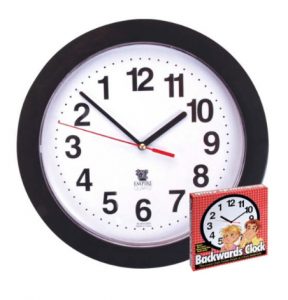 It’s all about time. How do we know what time it is, or know if if the clock we have is set correctly? What do we do? Live “out of sync” or reset? Our choices: Try to set everybody else to our time (not a good choice!), or the better choice to set our time to God’s time. Let’s ask God to reset our clocks and keep in time with God.
Archives
- March 2026
- February 2026
- January 2026
- December 2025
- November 2025
- October 2025
- September 2025
- August 2025
- July 2025
- June 2025
- May 2025
- April 2025
- March 2025
- February 2025
- January 2025
- December 2024
- November 2024
- October 2024
- September 2024
- August 2024
- July 2024
- June 2024
- May 2024
- April 2024
- March 2024
- February 2024
- January 2024
- December 2023
- November 2023
- October 2023
- September 2023
- August 2023
- July 2023
- June 2023
- May 2023
- April 2023
- March 2023
- February 2023
- January 2023
- December 2022
- November 2022
- October 2022
- September 2022
- August 2022
- July 2022
- June 2022
- May 2022
- April 2022
- March 2022
- February 2022
- January 2022
- December 2021
- November 2021
- October 2021
- September 2021
- August 2021
- July 2021
- June 2021
- May 2021
- April 2021
- March 2021
- February 2021
- January 2021
- December 2020
- November 2020
- October 2020
- September 2020
- August 2020
- July 2020
- June 2020
- May 2020
- April 2020
- March 2020
- February 2020
- January 2020
- December 2019
- November 2019
- October 2019
- September 2019
- August 2019
- July 2019
- June 2019
- May 2019
- April 2019
- March 2019
- February 2019
- January 2019
- December 2018
- November 2018
- October 2018
- September 2018
- August 2018
- July 2018
- June 2018
- May 2018
- April 2018
- March 2018
- February 2018
- January 2018
- December 2017
- November 2017
- October 2017
- September 2017
- August 2017
- July 2017
- June 2017
- May 2017
- April 2017
- March 2017
- February 2017
- January 2017
- December 2016
- November 2016
- October 2016
- September 2016