
 “And whenever you fast, do not put on a dismal face like the hypocrites, for they disfigure their faces so as to show others that they are fasting. Truly I tell you, they have received their reward. But when you fast, put oil on your head and wash your face, so that your fasting may be seen not by others but by your Father who is in secret; and your Father who sees in secret will reward you. “Do not store up for yourselves treasures on earth, where moth and rust consume and where thieves break in and steal; but store up for yourselves treasures in heaven, where neither moth nor rust consumes and where thieves do not break in and steal. For where your treasure is, there your heart will be also” (Matthew 6:16-21).
Our neighbors are feeling more and more like strangers to one another every day. People report loneliness as a persistent experience more than 50% of the time. And our churches, for all their historical and intentional presence, have also become strangers in the community. Hoe can we turn strangers into friends? How can our places of mission and worship become more welcoming? Reach out and introduce yourself to a neighbor. Realize others are as awkward as you may be and still make the connection. Go ahead. During the Lenten journey, during the next 40 days, you may want to turn strangers into fellow travelers, companions, friends, to embrace God’s emerging future that leads to the cross and the empty tomb. “Don’t be a mean-faced people, cruel to grandmothers and babies alike” (Deut. 28:50). But, “Do be a place where the face of God can smile on others” (Num. 23:5). Putting on the Face of Grace is the Lenten Journey.
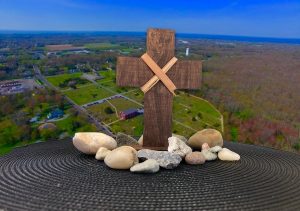 Around the tables you will find a pile of stones. Choose one to represent your burdens, your weights and fears, your stranger dangers, and remember as you carry this stone with you, that on Easter, at the end of the Lenten Journey, the stone was rolled away!
Honestly. Let’s ask ourselves:
What face does my neighborhood need to see in me today?
How will I put on the Face of Grace during the next 40 days?
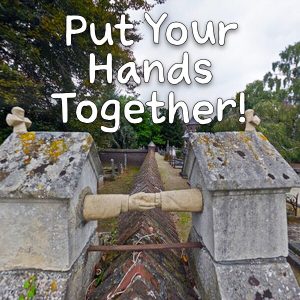 Our message this week from Pastor Kevin builds upon the recent theme of Jesus as the Bread of Life. We will consider Paul’s advice to citizens in Ephesus about using language that lifts people up in love, and do everything we can to put our hands together to ensure that everyone experiences that love. Take a look at the photo above of two clasped hands across a wall separating the Protestant graveyard from the Roman Catholic graveyard in Holland. In 1880, Colonel van Gorkum died in Roermond, Holland, and was buried in the Protestant cemetery because even though his wife Lady van Aefferden was Catholic, neither could be buried together. A few years later she died, but instead of being buried in her family plot, she chose a secluded spot at the wall that separated the Protestants from the Catholics and commissioned some clasped hands to connect with her husband’s tombstone to her’s symbolizing their love and togetherness. Language matters and how we think and how we speak to each other has profound consequences. Let’s speak to each other with love and in dignity and respect. With communion between Protestants and Roman Catholics remaining “closed,” this photo is a powerful symbol both of how far we’ve come and how far we have to go to put our hands together.