

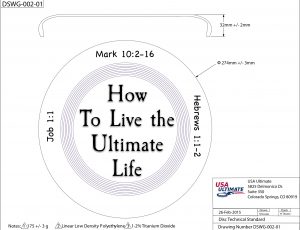
 Jesus said, “I have come that you might have life, and have it abundantly” (John 10:10). The word abundantly could also be translated ultimately. Jesus sails our life can be an ultimate life, a life experience beyond our greatest hopes or soaring imaginations! This week, we will find out how to live an ultimate life as we consider three related Bible texts about integrity, living our lives with a coherent sense of truth, respect, and character (Job 1:1ff; Hebrews 1:1-2ff; and Mark 10:2-16.) We will also learns few lessons from the Frisbee!
More than sixty years ago, the Frisbee flying disk was created by Walter Morrison and Warren Franscioni, in part inspired by the Roswell flying saucer sensation and originally called the Pluto Platter. Frisbee’s now famous name is a spin-off from a defunct Connecticut bakery, Frisbie Pie Company. New England college students often tossed empty pie tins around for fun, a habit that led them to refer to the Pluto Platter as a “frisbie.” Recently, the Frisbee is earning an even greater recognition than being one of the most well-known and well-loved flying toys of all time. The International Olympic Committee is considering adding competitive Ultimate Frisbee to the official sports line-up. (Ultimate will be the only sport not to have one of these _____. Can you guess? Listen for the correct answer!) This week at Cold Spring Church, find out how Jesus’ words and Ultimate Frisbee can inspire you to lead the Ultimate Life!
 What are some rules you remember? No running down the hallway? Sitting quietly in class. Hands and feet to yourself! Sure. Rules are necessary so that everyone can be treated fairly, with dignity and respect. We live our best life when we follow the right rules. You know, the game of Frisbee has rules, too. Here’s a Frisbee for you. Our game is to toss the Frisbee to the pew and the rule is throw it just hard enough so that it doesn’t end up in rear of the sanctuary! And it has to land on the bench. O.K. Play! Great. So each of you played the game and you followed the rules. God has given us some rules, too. We find them in God’s love letter to us we call the Bible. In the Bible we learn about how Jesus lived his life and how to make our life look more and more like his! They guide us. They remind us. And when we have Jesus in our heart, we can learn and grow to follow the rules on our own. Whether in games or in life, following the rules helps us to treat others with dignity and respect, and also have a lot of fun as we live our very best selves. Enjoy the Frisbees!
  Do you know what time it is? Just now, you likely paused to check. You may have looked to the clock on the wall, or the phone in your pocket. Maybe you raised your arm to glance at the watch on your wrist. Or called out, “Hey, Siri, what time is it?” You have your answer but what time is it, really? You’ve heard it said, “We have all the time in the world!” But have also been cautioned, “Time’s a’wasting.” How do we really know what time it is?
 It’s all about time. How do we know what time it is, or know if if the clock we have is set correctly? What do we do? Live “out of sync” or reset? Our choices: Try to set everybody else to our time (not a good choice!), or the better choice to set our time to God’s time. Let’s ask God to reset our clocks and keep in time with God.
 Make America Great Again is , well, a great slogan! It stirs our imaginations to conjure images of America as Great! But what is our frame of reference to be Great? Back a few centuries ago, America was considered Great because it was the friend of all, welcoming of every religion, even the Puritans (who were kicked out of England because their faith was just weird), the Anabaptists (who fled Europe because their faith was non-conformist), the Roman Catholics (who were feared to be worshipping a prince in a tall white hat instead of the Prince of Peace), and welcoming of Italians, Germans, Scots, French, Asian, African, and South American countries, too. Being great means no one is left behind. There is room for you. One more. The ones no one else seems to want. The others who are forgotten. Being Great as in winning the Great War, enjoying the Greatest Show on Earth, hearing the Greatest story ever told, singing Great is Thy Faithfulness, and recalling Jesus tell his disciples, Greater things you will do, are all, as I said, really great. Aspiring to greatness can be a great thing to aspire to. But what is great? And how do we as individuals become truly great? How do our communities become great? How can Cold Spring Church become great?